Surveyors Went Out to Settle a Land Dispute in Rural Kentucky. They Found an Entire Forgotten Town.
Property disputes in rural Appalachia have a long and complicated history. The land itself is the issue — it always has been. Deeds written a century ago reference trees that no longer exist and creeks that have shifted course. Boundaries described by compass headings and stone markers become, over time, suggestions. Families feud over lines that were never precisely drawn to begin with, and the courts have been sorting it out, slowly and expensively, for generations.
So when a dispute over a tract of land in eastern Kentucky escalated to the point of requiring a formal survey in the early 2000s, nobody expected the surveyors to find anything particularly interesting. They expected to find trees, rocks, and mud. They expected to produce a map, file a report, and let the lawyers argue about it.
Instead, they found a town.
What Was Hiding in the Trees
The property in question sat on several hundred acres of heavily wooded terrain that had passed through multiple hands over the decades, each transfer recorded with varying degrees of precision. The current owner had purchased it with the understanding that it was undeveloped land — valuable for timber, possibly for mineral rights, but otherwise unremarkable.
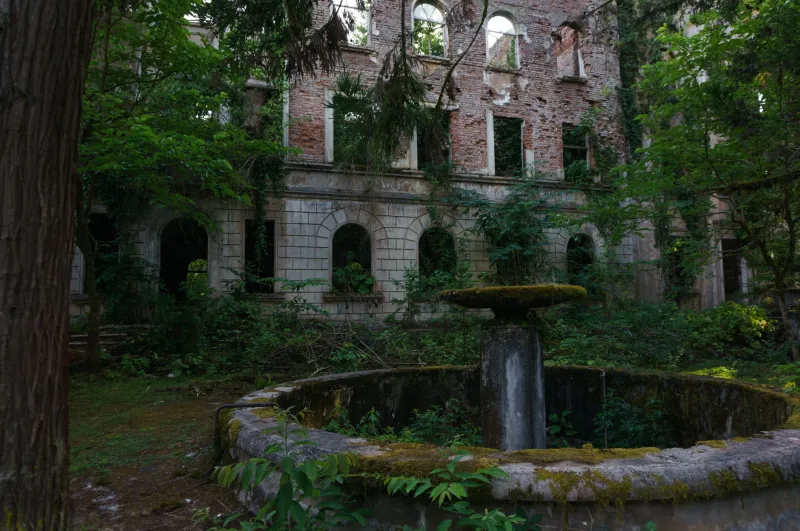
The surveyors, working their way through the undergrowth with GPS equipment and old deed records, began noticing things that didn't belong in undeveloped land. Foundations. Concrete pads. The remnants of what had clearly been a road, its gravel base still distinguishable beneath fifty years of leaf litter. A well, capped and overgrown. The skeletal frame of at least two structures that, with some vegetation cleared away, revealed themselves to be buildings — not cabins, not outbuildings, but actual commercial or civic structures, their bones still standing.
Further investigation, which quickly expanded beyond the original scope of the survey, uncovered the footprint of what had been a functioning community — a company town, as best as anyone could determine, built in the 1920s to house and serve workers from a coal or timber operation that no longer existed and, it turned out, was barely documented anywhere.
How a Town Disappears
The question that naturally follows is: how does an entire town vanish?
The answer, in Appalachian Kentucky, is less surprising than it might be elsewhere. Company towns — communities built and owned entirely by a single industrial employer — were common throughout the region during the coal and timber booms of the early twentieth century. They were self-contained: the company owned the houses, the store, the roads, sometimes the church. Workers were paid in company scrip, spent it at the company store, and lived entirely within an ecosystem controlled by a single corporate entity.
When the operation closed — as it inevitably did, when the seam ran out or the market collapsed or the company went under — the town closed with it. Workers left. The company, if it still existed in any form, had no interest in maintaining the property. If the land was sold, it was sold as raw acreage. The structures were left to the weather.
In a region with heavy tree cover and high rainfall, fifty years is enough time for nature to do significant editorial work. Roads disappear under vegetation. Wood rots. Brick crumbles. The landscape reasserts itself with remarkable efficiency, and within a generation or two, there's no one left who remembers what was there.
This particular town had the additional misfortune of being poorly documented even when it was alive. Company towns often didn't appear on official municipal maps because they weren't municipalities — they were private property. They had no mayor, no city council, no relationship with county government beyond the taxes the company paid. They existed, thrived, and vanished entirely within the private sector, leaving almost no paper trail in public records.
The Legal Tangle
The discovery transformed the property dispute from a straightforward boundary argument into something considerably more complicated.
The presence of structures — even ruined ones — raised questions about historical use rights, about what exactly had been sold when the land changed hands, and about whether any descendants of former residents might have claims of any kind. Historians and preservationists got involved. The state's historic preservation office sent representatives to assess whether anything on the site qualified for protection.
The original property owner, who had purchased what he understood to be a blank canvas, found himself at the center of an expanding bureaucratic and historical inquiry that had nothing to do with the boundary line he'd been trying to establish.
The legal proceedings, by multiple accounts, became considerably more expensive than anyone had anticipated.
What Gets Lost and Why
The Kentucky ghost town story is, at its core, a story about institutional memory — specifically, about how much of American history exists outside institutions entirely.
Official records capture what governments choose to track. Census data, deed registries, municipal incorporation documents — these form the skeleton of the historical record. But enormous amounts of American life happened in spaces that government never formally acknowledged: company towns, informal settlements, communities that organized themselves without ever filing paperwork with a county clerk.
When those communities disappeared, they disappeared completely. No archive held their records because they'd never submitted records to an archive. No historical society had collected their photographs because no one had thought to collect them while the town was alive. The people who remembered them aged out of living memory, and the land grew over.
The surveyors who stumbled onto this particular town weren't historians. They were there to measure a property line. But they ended up doing something historians had failed to do: they found a community that had been erased — not by catastrophe, not by deliberate concealment, but simply by the ordinary passage of time and the systematic indifference of official record-keeping to anything that didn't require a permit.
Somewhere in eastern Kentucky, under fifty years of trees, a town waited to be found.
All it took was an argument about a fence line.