Approved, Funded, and Abandoned: The Ohio Bridge That Couldn't Survive Its Own Paperwork
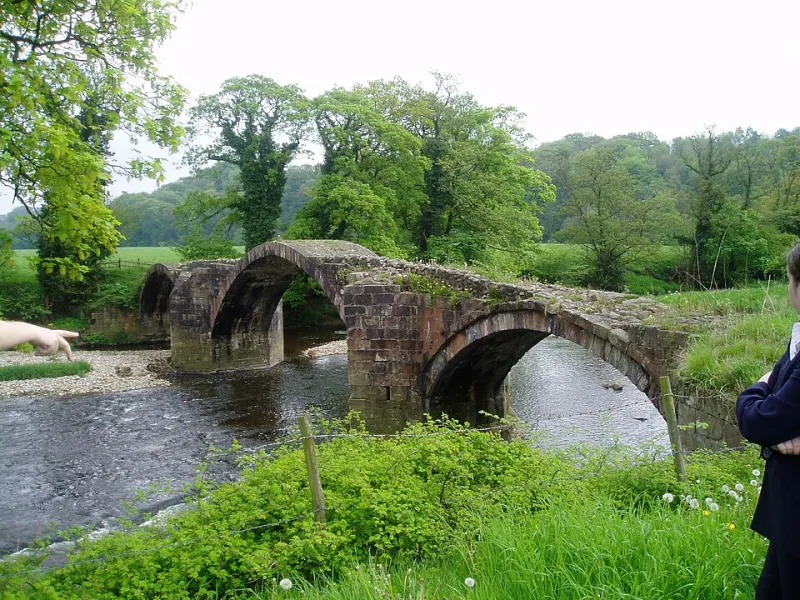
Photo: Matt-rex at English Wikipedia, Public domain, via Wikimedia Commons
Approved, Funded, and Abandoned: The Ohio Bridge That Couldn't Survive Its Own Paperwork
America has a well-documented infrastructure problem. Bridges age. Funding dries up. Political will evaporates. Projects die in committee, buried under competing priorities and shrinking budgets.
This is not that story.
This is the story of a bridge that had the money. Had the engineering. Had the congressional approval. Had, on three separate occasions across sixty years, everything a bridge needs to become a bridge — except, apparently, the basic cosmic permission to exist. What killed it each time wasn't opposition or underfunding or corruption. It was something far more difficult to argue with: the sheer, grinding, almost supernatural incompetence of American administrative process.
The First Attempt: A Deed That Disappeared
The crossing in question spans a modest stretch of river in rural Ohio, connecting two small communities that had been lobbying for a bridge since the early twentieth century. The river wasn't wide, the engineering wasn't complicated, and the need was genuine — residents were driving significant distances to reach the nearest existing crossing, and local commerce suffered accordingly.
By the late 1920s, the communities had done everything right. They'd organized, petitioned, sent delegations to Columbus and eventually to Washington. Congress allocated funds. Engineers were hired. Surveys were completed. The project was, by every official measure, a go.
Then the land acquisition hit a wall.
The approach on one bank required a small parcel of land that had changed hands several times over the preceding decades. When the state moved to acquire the necessary deed, it discovered that the most recent transfer — a routine transaction from years earlier — had never been properly recorded with the county. The deed existed. The sale had happened. But the paperwork had been filed in the wrong county office, sat in the wrong drawer, and was eventually absorbed into a box of miscellaneous documents that was relocated during a courthouse renovation.
By the time the error was discovered, the supervising engineer had accepted a position in another state, the federal funding window had closed, and the project was formally suspended. It would be re-examined, officials promised, at a later date.
The deed was eventually found, years later, in a filing cabinet that had been moved to a storage room and then, by some institutional accident, to a different building entirely. By then, nobody was looking for it anymore.
The Second Attempt: The Clerk Who Retired on a Thursday
The second attempt came in the late 1950s, when federal highway funding was flowing generously and the communities near the crossing tried again. The post-war era was a golden age for American infrastructure — the Interstate Highway System was being born, money was available, and small rural crossings were getting funded alongside major highways.
This attempt got further than the first. The land was secured, the engineering was updated for modern specifications, contracts were drafted, and a construction timeline was established. The project sat in the final administrative queue, waiting for the signature of a specific federal regional coordinator whose approval was required to release the construction funds.
The coordinator signed the authorization on a Wednesday.
He retired on Thursday.
What happened next is a masterpiece of bureaucratic timing. His replacement — appointed from outside the regional office and unfamiliar with the pending project queue — arrived to find a desk stacked with files awaiting transition. The bridge authorization, already signed, was placed in an outgoing folder to be processed and transmitted to the state.
Somewhere between that folder and the state office in Columbus, the transmission didn't happen. The exact mechanism of failure was never definitively established. The outgoing folder may have been misfiled during the office transition. The document may have been assumed by the incoming coordinator to be something already handled. Whatever the cause, the authorization simply did not arrive.
The state, waiting on the federal paperwork, eventually sent an inquiry. The federal office, now fully transitioned to new leadership, could find no record of the signed document in their active files. The signed original was eventually located — months later — in the retired coordinator's outgoing folder, which had never been processed and had been boxed up with his personal effects during the office cleanout.
By then, the construction season had passed, the contractors had committed to other projects, and the funding allocation had been redirected by Congress in a budget revision. The project was suspended again. For the second time.
The Third Attempt: The Map That Lied
By the 1980s, the bridge had become something of a local legend — a piece of infrastructure so persistently unlucky that residents had begun to treat it as a running joke. Still, the need remained. The communities were larger now. The detour was longer, relatively speaking, as traffic patterns had shifted. A new generation of local officials decided to try again.
The third attempt was the most thorough. Officials had learned from history. They hired a dedicated project coordinator whose sole job was to shepherd the application through every administrative step. They documented everything. They followed up on every transmission. They got the land secured, the engineering done, the environmental reviews completed. Congress approved the funding. The state matched it. The project was, once again, officially ready to build.
The construction bid documents went out. Contractors submitted proposals. A winning bid was selected. A groundbreaking date was set.
Then someone noticed the map.
The official project map — the document that defined the precise location and alignment of the bridge — contained a printing error. The scale notation on one section was incorrect, a small but consequential mistake that meant the legal description of the bridge's footprint didn't precisely match the actual survey coordinates on file. It was a minor discrepancy. The kind of thing that, in a functional administrative environment, gets corrected with a quick amendment and a phone call.
But the discrepancy had been incorporated into the federal funding authorization, which meant it was now embedded in a legal document that required a formal correction process to amend. The correction process required sign-off from multiple offices. One of those offices was in the middle of a federally mandated reorganization. The sign-off took longer than expected. The construction season passed. The contractor's bid expired. The project had to be re-bid.
The re-bid process revealed that construction costs had increased significantly in the intervening period. The approved funding no longer covered the project. A supplemental appropriation would be needed. Congress, by then occupied with other priorities, did not act on the supplemental request before the session ended.
The bridge was suspended for the third time.
What It All Means
The crossing was eventually built — quietly, in the 1990s, as part of a broader regional transportation package that bundled it with several other projects and moved it through the system before any single piece of paperwork could go missing.
It is, by all accounts, a perfectly ordinary bridge. It does what bridges do. Nobody drives across it thinking about the decades of misfiled deeds and retired clerks and misprinted maps that stood between its absence and its existence.
But the story it carries is worth something. Not as a cautionary tale about corruption or indifference — there was none of that here. Everyone involved, at every stage, was trying to do their job. The money was real. The need was real. The will was real.
Sometimes that's just not enough. Sometimes the paperwork wins.