He Charged His Neighbors a Dollar to Drive Past His Mailbox — and the Law Said He Could
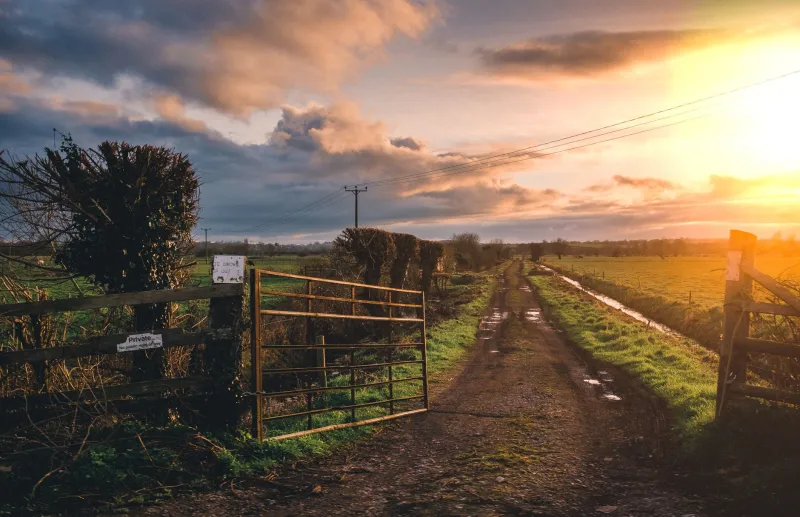
Most people who dig through old property records are looking for boundary lines or unpaid liens. Raymond Coulter was just bored. It was 2003, he was retired, and he'd recently moved to a rural stretch of Lancaster County, Pennsylvania, where his modest six-acre property happened to sit across the only gravel road connecting four neighboring homes to the county highway.
What he found in those records would turn his cul-de-sac into a courtroom drama that local attorneys still bring up at continuing education seminars.
A Document Nobody Remembered
The easement in question dated to 1927. It was a formal, notarized agreement between the original landowner — a farmer named Elias Breneman — and the county, granting neighboring parcels the right of passage across his land "in exchange for reasonable compensation to be determined by the grantor."
That last clause is the one that mattered.
Decades of subsequent property transfers had carried the easement forward without anyone noticing the compensation language. By the time the surrounding lots were developed into residential homes in the 1970s and 1980s, the road had simply become an assumed right-of-way. Nobody paid anyone anything. Nobody thought they had to.
Coulter, who had spent thirty-two years as an insurance adjuster and had a professional appreciation for fine print, thought differently.
"The document says 'reasonable compensation,'" he later told a local reporter. "It doesn't say zero."
The Toll Goes Up
In the spring of 2004, Coulter erected a simple wooden gate across the gravel road and posted a hand-painted sign: PRIVATE ROAD — $1.00 PER VEHICLE — HONOR SYSTEM. He placed a metal lockbox on a fence post.
His neighbors were not amused.
The four households who depended on the road — representing about eleven adults and several children with school buses to catch — immediately consulted attorneys. The consensus among three separate lawyers was that Coulter didn't have a leg to stand on. The road had been used freely for decades. Surely that constituted some form of implied abandonment of the compensation clause.
Except it didn't. Not in Pennsylvania.
Coulter filed a quiet title action in Lancaster County Court of Common Pleas, essentially asking a judge to formally confirm what the 1927 document already said. The neighbors countered with an adverse possession argument — the idea that long, uncontested use of land can eventually create legal rights.
The judge sided with Coulter on the core question. The compensation clause had never been voided, waived in writing, or legally extinguished. The easement was real. The toll was, technically, enforceable.
What "Reasonable" Actually Means
Here's where things got genuinely strange.
The ruling didn't specify what "reasonable compensation" meant. That was left to negotiation — which is a polite word for what actually happened, which was eighteen months of increasingly absurd back-and-forth between Coulter, his neighbors, and their respective attorneys.
Coulter's initial ask was $1 per vehicle per trip, which he calculated would generate roughly $2,000 annually based on observed traffic. His neighbors offered a one-time lump sum of $500 to permanently satisfy the clause. Coulter declined. They came back with $1,200. He declined again.
At one point, a neighbor proposed paying in the form of property maintenance — mowing Coulter's lawn, salting his driveway in winter. Coulter considered it. Then he didn't.
What finally broke the impasse was a detail that Coulter's attorney introduced almost as an aside: because the road crossed his property, Coulter was also technically responsible for its upkeep under county code. Gravel roads don't maintain themselves. Suddenly, the economics shifted.
The final settlement, reached in late 2005, required the four neighboring households to collectively pay Coulter $3,400 annually — adjusted for inflation every five years — in exchange for unobstructed access. In return, they shared road maintenance costs. Both sides signed. Both sides stopped talking to each other at neighborhood gatherings.
Why This Keeps Happening
Property law in the United States is genuinely ancient in places. Many states — particularly in the Northeast and Mid-Atlantic — have easements, covenants, and deed restrictions dating back centuries that were never formally retired when the land changed hands. They just got buried under layers of new paperwork.
Most of the time, nobody notices. The language sits in county deed books, technically binding, practically forgotten.
Occasionally, someone notices.
Property attorneys have a term for these situations: "sleeping giants." They're clauses that were perfectly sensible in 1890 or 1927 or 1952 that have simply drifted out of alignment with modern assumptions about how land works. They don't expire. They don't fade. They just wait.
Coulter's case became something of a teaching example — not because it was unique, but because he actually followed through. Most people who discover something like this use it as leverage in a dispute and then let it drop. Coulter built a gate.
"I wasn't trying to be difficult," he said in a 2006 interview. "I just thought, if it's in the document, it means something. Turns out it did."
His neighbors, for what it's worth, eventually installed a keypad gate themselves — one that Coulter's code also opens. Some compromises look a lot like détente.