The Most Dangerous Books in Ohio
In 1954, Martha Henderson thought she was just doing her job. As head librarian of the Millfield Public Library in rural Ohio, she prided herself on fulfilling every interlibrary loan request that crossed her desk, no matter how obscure. When researchers from universities, government contractors, and even foreign institutions requested technical documents about radar systems, she dutifully tracked them down and sent them along.
What Henderson didn't know was that she had accidentally become one of the Cold War's most prolific intelligence assets — for the wrong side.
The Paper Trail That Led Nowhere
The trouble started with America's haphazard approach to classifying scientific information in the early 1950s. While obviously sensitive military documents were locked away, thousands of technical reports from government-funded research projects ended up in a bizarre gray area. They weren't officially classified, but they contained detailed information about cutting-edge radar technology, missile guidance systems, and electronic countermeasures.
Through a series of bureaucratic oversights, many of these reports found their way into university libraries and technical archives across the country. The government assumed that academic institutions would naturally restrict access to sensitive materials. Academic librarians assumed that if documents weren't marked classified, they were fair game for anyone who requested them.
Martha Henderson fell squarely into the second category.
The Dewey Decimal System Meets Espionage
Henderson's library had joined an ambitious interlibrary loan network that allowed researchers anywhere in the country to request materials from participating institutions. The system worked beautifully — perhaps too beautifully. Foreign intelligence services quickly realized they had stumbled upon an unprecedented opportunity.
Instead of attempting dangerous infiltration of military facilities or recruiting high-level assets, Soviet and Eastern European agents could simply pose as legitimate researchers and request sensitive documents through normal library channels. The requests looked entirely innocent: a graduate student working on a thesis about electromagnetic theory, a professor researching antenna design, an engineer studying frequency modulation.
Henderson processed dozens of these requests over several years, never suspecting that the polite letters from "Dr. Petrov at the University of Prague" or "Professor Schmidt from the Technical Institute of Dresden" were anything other than legitimate academic inquiries.
The Discovery That Changed Everything
The scheme unraveled in 1957 when a CIA analyst noticed something peculiar while reviewing intelligence reports. Technical information that should have been closely guarded was showing up in Soviet publications with suspicious accuracy. After months of investigation, agents traced the leak back to an unlikely source: interlibrary loan records.
Further investigation revealed that foreign agents had systematically requested materials from libraries across the Midwest, with Henderson's facility serving as an unwitting hub for the operation. The small-town librarian had unknowingly distributed enough sensitive information to fill several filing cabinets at the Kremlin.
The Quiet Intervention
Rather than create a public scandal, the government chose a typically bureaucratic solution. CIA agents quietly visited libraries across the country, including Henderson's, under the cover of conducting a "routine audit of federal document distribution." They politely requested that certain materials be removed from circulation and that future requests for technical documents be forwarded to a new "interdepartmental review board" for approval.
Henderson cooperated fully, though she never understood why the government suddenly cared so much about antenna theory and radar specifications. The agents never told her that she had been running an accidental intelligence operation, and she continued her career believing she had simply gotten caught up in some tedious new federal paperwork requirements.
The Lasting Legacy
The Millfield incident, as it came to be known in classified circles, prompted a complete overhaul of how the U.S. government handled scientific information. New classification systems were implemented, stricter controls were placed on technical documents, and the freewheeling days of unrestricted interlibrary loans for sensitive materials came to an end.
Martha Henderson retired in 1972, having served her community faithfully for over three decades. Her colleagues threw her a small party and presented her with a plaque recognizing her dedication to "connecting researchers with the information they needed." The irony was entirely unintentional, but it would have amused the CIA agents who still kept her file in their archives.
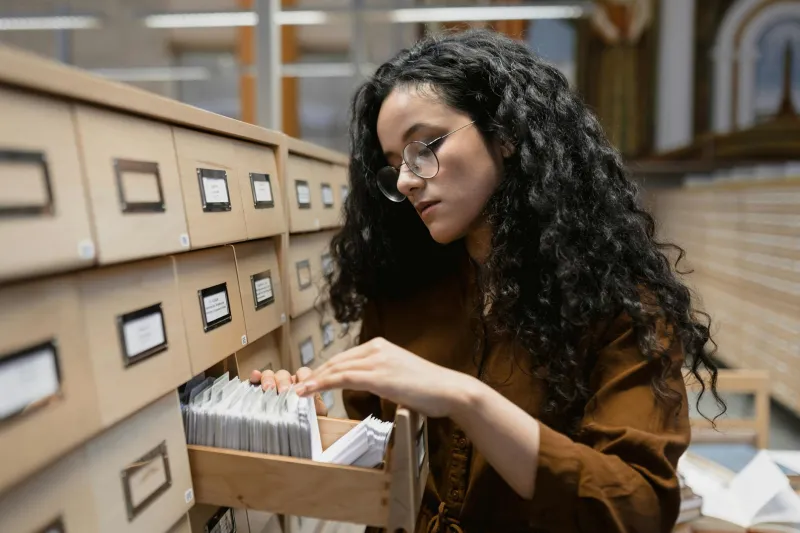
Today, the Millfield Public Library operates much like any other small-town institution, lending out romance novels and hosting children's story time. But for a brief period during the height of the Cold War, it served as an unlikely battlefield in the intelligence wars — one where the most dangerous weapon was a well-organized card catalog and a librarian's commitment to customer service.
The episode remains a testament to how easily bureaucratic oversights can create security nightmares, and how the most ordinary people can find themselves at the center of extraordinary events without ever knowing it. Sometimes the most effective spies are the ones who don't even know they're spying.