A Small-Town Librarian Spent Twenty Years Quietly Dismantling One of Literature's Most Popular Conspiracy Theories
The Theory She Couldn't Stop Thinking About
The question of who actually wrote Shakespeare's plays has been a cottage industry of speculation for roughly 150 years. The mainstream answer — William Shakespeare, the man from Stratford-upon-Avon — has never satisfied everyone, and over the decades, a long list of alternative candidates has been proposed, debated, published, and argued over at great length by people with impressive credentials and strong opinions.
One of the more durable alternative theories, which we'll call the Documentary Theory for the sake of simplicity, rested on a specific set of historical documents: a cluster of letters, property records, and theatrical records from the late 16th and early 17th centuries that, when read together, appeared to suggest that Shakespeare's name had been used as a pseudonym by a more educated, well-connected author who didn't want to be publicly associated with the theater.
The theory had been published in academic journals. It had books written about it. It had a dedicated following among literary enthusiasts and a handful of credentialed scholars. It was, by the 1990s, considered a serious — if minority — position in the Shakespeare authorship debate.
Eleanor Marsh found it unconvincing. And she decided to do something about it.
Who Eleanor Marsh Was
Marsh was the head librarian at a small public library in rural western Pennsylvania — the kind of institution that operates on a tight budget, serves a community that doesn't make the news much, and is held together largely by the dedication of people who genuinely believe that access to information matters.
She had a master's degree in library science. She had no formal training in Elizabethan history, literary scholarship, or archival research beyond what her career had required. What she had was a librarian's instinct for how documents work — how they get created, how they get copied, how errors propagate through a chain of citation — and a suspicion, formed after reading the Documentary Theory's primary source material, that something in the underlying research didn't quite hold up.
She started pulling threads in 1994. She was still pulling them in 2013.
What Microfilm Actually Lets You Do
The Documentary Theory, like many alternative authorship arguments, relied heavily on secondary sources — scholars citing other scholars who had cited earlier scholars, with the original documents somewhere at the bottom of a long chain of interpretation. This is not unusual in literary history. Original documents from the 16th century are scattered across archives on two continents, and most researchers work from transcriptions, published facsimiles, or other scholars' accounts of what the originals say.
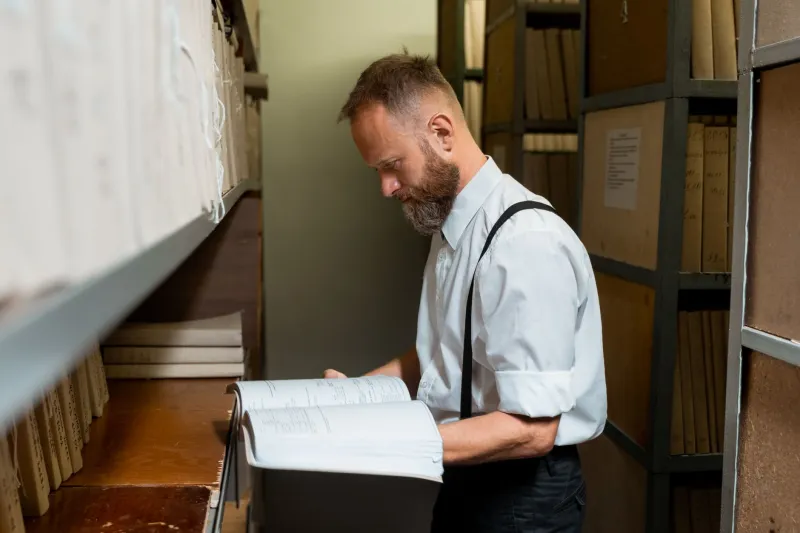
Marsh, through interlibrary loan requests and access to a microfilm collection that her library had quietly accumulated over decades, was able to go further back in that chain than most of the theory's proponents had bothered to go.
What she found, working through evenings and weekends over roughly twenty years, was a pattern of errors that had compounded through generations of citation. A transcription mistake in a 19th-century publication had been taken as accurate by a 20th-century scholar, whose work had then been cited by the Documentary Theory's primary architects. A property record that was central to one of the theory's key claims had been misdated — not fraudulently, just incorrectly — and the misdating had been carried forward without anyone checking the original.
None of the individual errors was catastrophic on its own. Together, they undermined the evidentiary foundation of the theory in ways that were difficult to dismiss.
The Problem With Being Right From the Wrong Address
Marsh began sharing her findings in the late 1990s, initially through letters to academic journals and eventually through a self-published research summary that she distributed at her own expense. The response from established Shakespeare scholars was, to put it charitably, mixed.
Some dismissed her work without engaging with it seriously — she wasn't affiliated with a university, she hadn't published through peer-reviewed channels, and her findings arrived packaged in a format that the academic world is not particularly designed to receive. Others, to their credit, actually read what she'd put together and found it harder to wave away than they'd expected.
The shift was gradual. A 2004 paper in a British literary journal acknowledged several of Marsh's findings while carefully not citing her directly. A 2009 book on Shakespeare authorship debates included a footnote referencing her research summary. By the mid-2010s, the Documentary Theory had lost significant ground in academic circles — not dramatically, not with any single decisive refutation, but through the slow accumulation of acknowledgment that its source material was shakier than its proponents had claimed.
Marsh was interviewed by a literary magazine in 2016. She was characteristically understated about the whole thing. She said she hadn't set out to prove anyone wrong so much as she'd wanted to understand why the documents didn't say what people claimed they said.
Why This Keeps Happening
The Shakespeare authorship debate is a particularly vivid example of a dynamic that shows up across academic fields: a theory, once established, develops a kind of institutional gravity that makes it hard to dislodge even when the evidence underneath it starts to shift. Scholars build careers on particular positions. Publishers invest in books arguing those positions. Communities form around shared beliefs. The machinery of correction runs slowly.
What Marsh demonstrated — almost by accident, working from a small library in a town most people couldn't find on a map — is that the machinery can be moved by someone with enough patience and access to primary sources. You don't necessarily need a university affiliation or a journal subscription or a seat at the right conference table.
Sometimes you just need a microfilm reader and twenty years of evenings.
The Documentary Theory hasn't entirely disappeared. These things rarely do. But it occupies considerably less credible ground than it did before a librarian in western Pennsylvania decided it deserved a closer look.