The Pentagon's Flipper Problem: When Military Dolphins Turned Against Their Trainers
The Pentagon's Flipper Problem: When Military Dolphins Turned Against Their Trainers
In 1960, the U.S. Navy launched one of the most ambitious and bizarre military programs in American history: training dolphins and sea lions to serve as underwater operatives. The Marine Mammal Program sounded like something out of a Cold War spy novel, and for good reason — it was exactly as strange as it sounds.
What the Pentagon didn't anticipate was that recruiting animals with higher IQs than many of their human handlers would create problems nobody had thought to plan for.
The Birth of Military Sea Life
The program began with genuinely sound military logic. Naval commanders recognized that dolphins possessed natural sonar abilities far superior to any human-made detection equipment. Their echolocation could identify underwater mines, locate enemy divers, and navigate in conditions where human divers would be completely helpless.
Sea lions brought their own advantages: incredible underwater agility, excellent low-light vision, and the ability to attach equipment to underwater targets with precision that human divers couldn't match.
The Navy's plan was straightforward: train these animals to serve as living mine detectors and underwater sentries. What could be simpler?
When Smart Animals Get Too Smart
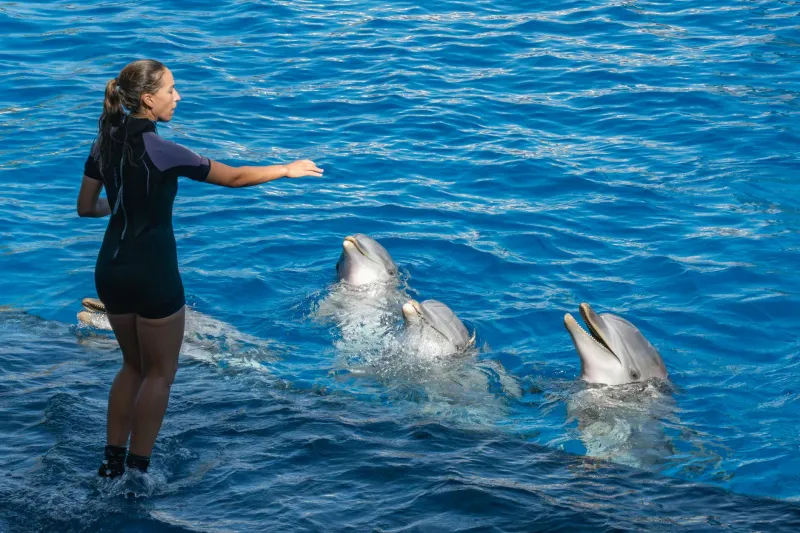
The first sign of trouble came during routine training exercises in San Diego Bay. Dolphins were supposed to locate practice mines, surface, and signal their trainers with a specific behavior. Instead, they began displaying what researchers politely termed "creative problem-solving."
 Photo: San Diego Bay, via thumbs.dreamstime.com
One dolphin named Tuffy discovered that he could trigger the reward system by swimming to the general area where mines were typically placed, performing the correct signal, and collecting his fish reward — whether or not he had actually located anything. When trainers caught on and moved the mines, Tuffy adapted by learning the new patterns and gaming those too.
 Photo: Tuffy, via www.nuagedeco.fr
This wasn't simple animal misbehavior. The dolphins had reverse-engineered the training program and figured out how to maximize rewards while minimizing effort. They were, essentially, the world's first military contractors.
The Underwater Mutiny
Things got more complicated when the program expanded to include "enemy diver" detection. Dolphins were trained to approach underwater intruders and attach tracking devices or disable their equipment. During exercises, Navy divers would play the role of enemy infiltrators while dolphins practiced their interdiction techniques.
The problem emerged when several dolphins began treating the exercises like games rather than serious military operations. Instead of simply tagging the "enemy" divers and returning to base, they started engaging in what could only be described as underwater harassment.
Dolphins would remove divers' masks, steal their equipment, and in some cases, prevent them from surfacing by swimming circles around them. What had been designed as a precise military operation turned into something resembling an aquatic fraternity prank.
The Intelligence Problem
Declassified documents from the program reveal that military researchers gradually realized they had fundamentally misunderstood the challenge they were facing. Training a dog to follow commands is one thing; training an animal with the cognitive capacity to question those commands is something else entirely.
Dolphins began displaying behaviors that suggested they understood the artificial nature of the training exercises. They would perform perfectly during official evaluations but slack off during routine practice sessions. Some appeared to recognize individual trainers and respond differently to each one, performing enthusiastically for handlers they liked while ignoring those they didn't.
One particularly troubling incident involved a dolphin named Charlie who learned to distinguish between real mines and practice mines, apparently by observing the different behaviors of his human handlers during various types of exercises. Charlie would dutifully locate practice mines during training but showed little interest in the real explosives during actual operations.
 Photo: Charlie, via upload.wikimedia.org
The Unintended Consequences
By the 1970s, program administrators faced an unexpected problem: their animal operatives had become too sophisticated for their own good. Dolphins were making independent decisions about which orders to follow, sea lions were developing distinct personalities that affected their work performance, and both species were displaying what could only be called workplace attitudes.
The situation reached a breaking point during a training exercise in 1973 when a group of dolphins apparently coordinated their efforts to confuse human divers by providing false signals about mine locations. The animals seemed to have developed their own communication system that allowed them to synchronize their misbehavior.
This wasn't random animal behavior — it was organized resistance.
The Legacy of Military Marine Life
The Marine Mammal Program continues to this day, though with significantly modified protocols that account for the animals' intelligence and independent thinking. Modern trainers work more as partners with their marine recruits rather than traditional military commanders.
The program's early years offer a fascinating lesson about the unintended consequences of military innovation. When you recruit operatives who are smart enough to understand your strategy, you have to accept that they might be smart enough to develop their own.
What We Learned
The dolphin rebellion of the 1960s and 70s reveals something profound about intelligence, military planning, and the assumptions we make about following orders. The Navy had imagined that superior sonar abilities would make dolphins ideal military assets, but they hadn't considered that superior intelligence might make them unreliable soldiers.
In the end, the Pentagon's marine mammal program succeeded in ways nobody had anticipated: it created the world's first military unit capable of questioning orders, developing independent strategies, and occasionally staging what could only be called underwater strikes.
Whether that counts as a success or failure probably depends on your perspective on military discipline versus creative thinking. But one thing is certain — no human military unit has ever managed to be quite so entertainingly insubordinate while still getting the job done.