This Shade of Blue Is Taken: The Small Company That Held an Entire Industry Hostage Over a Color

Photo by Photo by CHUTTERSNAP on Unsplash on Unsplash
You Can't Own a Color. Except When You Can.
If someone told you that a single company had trademarked a specific shade of blue — not a logo, not a product name, just the color itself — and then used that trademark to drag competitors into court for years, you'd probably assume they lost. Obviously. You can't own a color. That's not how any of this works.
Except it is, apparently, exactly how some of this works. And in the 1990s, one small American textile manufacturer proved it in the most disruptive way possible.
The case that followed didn't just affect the textile industry. It sent ripples through fashion, packaging, manufacturing, and marketing — and the legal precedent it helped establish is still shaping trademark disputes today, mostly in ways the general public has no idea about.
The Mechanics of Owning Something Nobody Thought Was Ownable
American trademark law exists to protect brand identity. The logic is straightforward: if you've built a reputation around a name, a logo, or a distinctive visual element, competitors shouldn't be able to copy that element to confuse consumers. Trademarks are about source identification — they tell customers where a product comes from.
For most of trademark law's history, colors were considered off-limits. The reasoning was practical: there are only so many colors. If one company could own red, competitors would be locked out of a basic visual resource. Colors were what lawyers called "functional" — too fundamental to commerce to be monopolized by any single business.
Then, in 1995, the Supreme Court issued a ruling in Qualitex Co. v. Jacobson Products Co. that changed the calculation. The Court held that color alone could, under some circumstances, function as a trademark — specifically when that color had acquired what's called "secondary meaning," meaning consumers had come to associate that color with a particular source.
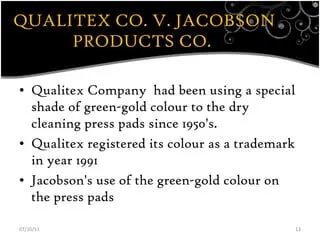 Photo: Qualitex Co. v. Jacobson Products Co., via image.slidesharecdn.com
The ruling was careful and narrow. But it opened a door. And a small textile manufacturer was ready to walk through it.
The Shade Nobody Thought to Protect Until Someone Did
The specific shade at the center of the dispute — a particular blue used in industrial and commercial textile applications — had been in common use across the industry for years. Multiple manufacturers used it. It wasn't proprietary. It wasn't distinctive. It was just a color that worked for the product.
The small manufacturer had used the color extensively and had the sales records to prove it. They also had the legal creativity to argue that, in their specific market segment, customers had come to associate that shade of blue with their products specifically. They filed for trademark protection.
The application was granted.
What happened next was, depending on your perspective, either a masterclass in aggressive legal strategy or a cautionary tale about what happens when intellectual property law collides with physical reality. The manufacturer began sending cease-and-desist letters to competitors who used the same shade. Some settled immediately, switching to different colors and absorbing the rebranding costs. Others fought back.
A Decade of Courtroom Chaos
The litigation that followed was sprawling and expensive. Competitors argued that the color had never acquired secondary meaning — that customers bought the product because of its function, not because they associated that particular blue with a single manufacturer. They argued that granting one company exclusive rights to a color in an industry created an unfair competitive advantage that trademark law was never designed to provide.
The manufacturer countered with consumer surveys, sales data, and years of marketing materials. Their attorneys were meticulous. Their case was, frustratingly for their competitors, reasonably well-constructed.
Courts across different jurisdictions reached different conclusions. Some found the trademark valid and enforceable. Others found it overbroad. The inconsistency created exactly the kind of legal uncertainty that makes industries nervous — nobody knew, from one court district to the next, whether using that shade of blue exposed them to liability.
The chaos spread beyond textiles. Packaging companies, apparel manufacturers, and industrial suppliers all found themselves tangled in the question of how far the trademark extended. If the color was protected in one application, was it protected in adjacent ones? Nobody had a clean answer.
What the Case Actually Changed
By the time the legal battles wound down, the practical outcome was mixed. The trademark was ultimately narrowed — courts drew tighter lines around the specific commercial context in which the color had acquired secondary meaning, limiting the manufacturer's ability to reach into unrelated industries.
But the broader impact on American trademark law was significant and lasting. The case became a reference point for how courts evaluate color trademark claims, pushing toward a more rigorous standard for what "secondary meaning" actually requires. Subsequent rulings in color trademark disputes — including high-profile cases involving the distinctive red soles of luxury shoes and the brown of a major delivery company's trucks — drew on the framework that emerged from this decade of litigation.
The rules that govern color ownership in the US today are, in part, a product of what one small textile company forced the legal system to figure out.
The Color Is Still Out There
Here's the quietly unsettling part: the shade of blue at the center of all this still exists. It's still used in industrial textiles. The trademark dispute is long over, the company that filed for protection has likely changed hands or disappeared entirely, and the color itself has returned to something like common use.
But for roughly a decade, a specific arrangement of light wavelengths — a color you could probably find on a paint chip at any hardware store — was legally owned. Competitors paid to avoid it. Lawyers billed millions of hours arguing about it. An entire industry reorganized itself around a single shade.
If that sounds implausible, it's because it is. But it happened. And the legal machinery it set in motion is still running.