Montana's Most Convincing Rock: How a Hillside Fooled Geologists for a Century
Science is supposed to be self-correcting. That's the whole pitch. You make a claim, someone checks your work, the truth wins out eventually. It's a reassuring idea. It's also, occasionally, completely wrong.
For the better part of a century, a quietly dramatic landform in rural Montana held a place of modest distinction in American geological literature. It was classified as an extinct volcano. It was cited in academic papers. It appeared in at least two widely used university geology texts. Professors mentioned it in lectures. Graduate students referenced it in footnotes.
The only problem: it wasn't a volcano. It had never been a volcano. It was just a rock formation that looked, to the untrained eye — and apparently to several trained ones — like it really, really wanted to be.
The Original Sin of the Misclassification
The story begins in the early 1900s, during a period when the American West was still being mapped and catalogued with something between scientific rigor and frontier enthusiasm. Geological survey teams were moving fast, covering enormous distances, and making field assessments under conditions that were, to put it generously, not ideal for careful analysis.
 Photo: American West, via img-s-msn-com.akamaized.net
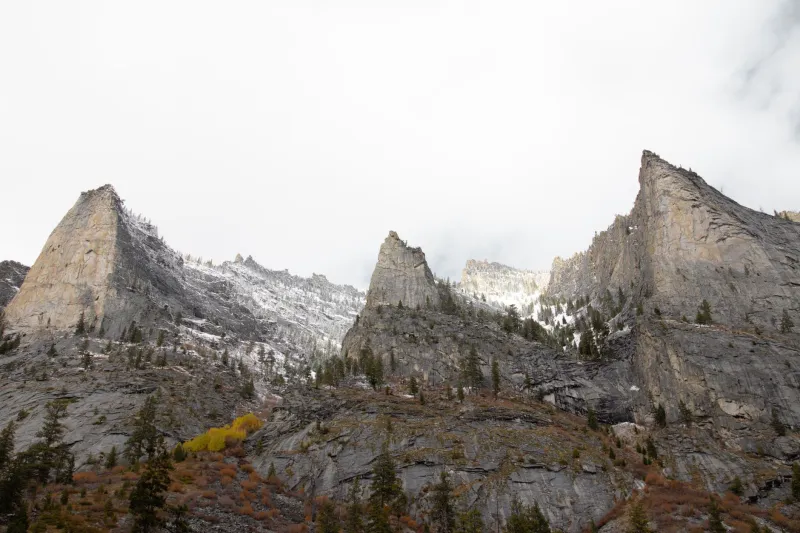
The formation in question — a dark, angular mass rising from the surrounding terrain with a distinctly conical silhouette — caught the attention of a survey geologist whose name has largely faded from the record. His assessment was confident: volcanic origin, likely Tertiary period, consistent with regional igneous activity. He noted the dark coloration of the rock, the way the terrain sloped away from the central mass, and the general absence of surrounding sedimentary layers. Classic volcanic indicators, he wrote.
What he apparently did not do was collect adequate samples for detailed petrographic analysis, or if he did, those samples were never rigorously examined against the original classification. His report was filed, circulated, and eventually folded into the broader geological literature of the region.
And there it stayed.
How a Mistake Becomes a Fact
Here's the part that should make anyone who's ever trusted a Wikipedia citation feel a little uneasy: scientific literature has a feedback loop problem. Once a claim appears in a credible source, subsequent researchers tend to cite it rather than re-examine it. Why wouldn't they? The fieldwork has already been done. The expert already weighed in. There are other things to study.
Over the following decades, the Montana formation accumulated citations the way a snowball accumulates mass rolling downhill. Each new mention added a layer of apparent legitimacy. By the time the formation appeared in a widely distributed university geology text in the 1940s, it had been cited enough times that questioning it would have felt almost rude.
This is sometimes called the "authority cascade" in the history of science — the phenomenon where a single confident assertion, repeated often enough by credentialed people, gradually transforms into received wisdom. Nobody is lying. Nobody is being lazy, exactly. They're just doing what researchers do: building on what came before.
The formation wasn't famous. It wasn't a landmark. It was just a footnote in the broader geological story of the region. But it was a footnote that said volcano, and for a long time, nobody saw any reason to argue.
The Graduate Student Who Wouldn't Let It Go
In the mid-1970s, a graduate student at a Montana university was putting together a regional geological survey as part of his dissertation fieldwork. He was thorough — annoyingly so, by some accounts — and when he came across the classified formation in the literature, something nagged at him.
He drove out to look at it.
What he found was a striking landform, no question. The dark rock, the conical shape, the way it dominated the surrounding landscape — he could see immediately why someone had made the call they made. But he also noticed things the original surveyor either hadn't seen or hadn't weighted properly. The rock composition, on closer inspection, didn't match volcanic basalt. The internal structure showed none of the flow characteristics you'd expect from cooled magma. The surrounding soil told a different story entirely.
He pulled samples. He ran analysis. He went back to the original survey report and read it, carefully, for what it actually said versus what people had assumed it meant.
His conclusion, laid out in a 1977 dissertation chapter that was not exactly celebrated at the time, was blunt: the formation was the product of differential erosion acting on a resistant igneous intrusion — a laccolith, most likely — that had been exposed over millions of years as softer surrounding material wore away. It looked volcanic the way a triangle looks like a mountain. The resemblance was real. The classification was not.
The Quiet Correction Nobody Announced
What happened next is almost as interesting as the original mistake. There was no dramatic retraction. No public correction. No formal announcement that a century of citations had been built on a shaky foundation.
The dissertation circulated. A few papers followed. Slowly, the classification was quietly updated in newer references, with the kind of understated language academics prefer — "previously described as volcanic in origin, now understood to reflect..." — as though the error had been a minor clerical issue rather than a hundred-year game of geological telephone.
The formation itself, for its part, looked exactly the same as it always had. Convincing as ever.
Which is maybe the most honest thing about this whole story. The rock didn't deceive anyone. It just sat there, doing what rocks do. The deception, such as it was, happened entirely among the humans who were supposed to be paying attention.
Science corrected itself. Eventually. It just took about ninety years longer than the brochure suggests.