She Thought She Knew Everything About Her Husband. Then She Found the Room He Never Told Her About.
Ruth Callahan had been married to Edward for thirty-one years. She knew how he took his coffee (black, too hot, always slightly too full). She knew he couldn't sleep without a fan running. She knew the particular silence he got when he was upset about something and wasn't ready to talk about it yet.
She did not know about the room.
The House That Came With a History
Edward Callahan died in 2019 at age 72, following a brief illness. He left behind a wife, three adult children, and the old family home in a small town in western Massachusetts — a Victorian-era house that had been in his family since the early 1900s. Ruth had always known the house as a kind of background presence in their marriage: Edward had grown up there, inherited it from his parents, and always spoken of it with a certain careful fondness that she'd never thought to examine too closely.
After his death, she decided to sell it. The house needed work, the town wasn't where her children lived, and the upkeep on a 120-year-old building was not something she wanted to manage alone. She hired a local contractor to assess what repairs would be needed before listing.
The contractor, a man named Pete Sorrento who had been doing renovation work in the area for twenty years, called her on a Tuesday afternoon about three weeks into the assessment. His tone, she later recalled, was carefully neutral in the way that people's voices get when they're not sure how you're going to react to something.
"There's a space down here I think you should come see," he said.
What Was Behind the Wall
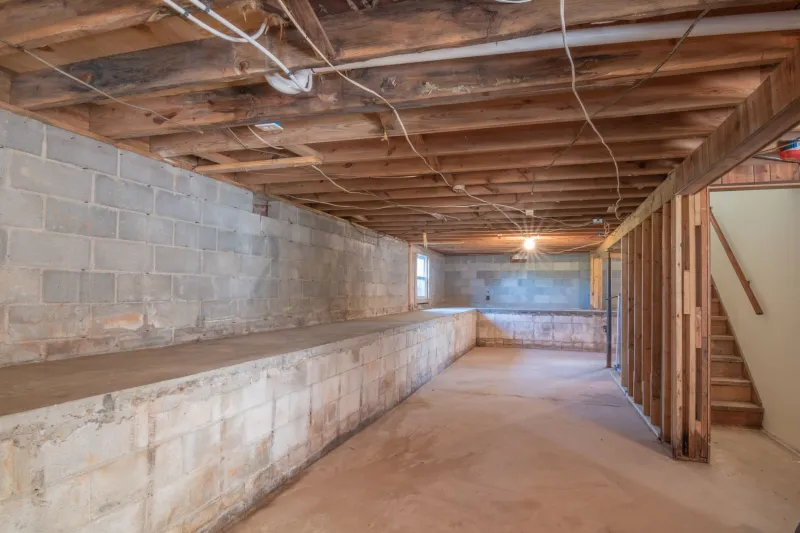
The basement of the house was unfinished, as most basements in houses of that age tend to be — stone foundation, low ceilings, a collection of old appliances and storage boxes that accumulate in basements the way sediment accumulates at the bottom of rivers. Sorrento had been inspecting the foundation wall on the north side when he noticed that one section of it didn't match the rest. The stonework was the same age, but the mortar was slightly different. And behind a large wooden shelving unit that had been bolted to the wall — not resting against it, bolted — the wall was hollow.
The shelving unit, once moved, revealed a door. The door was locked with a simple padlock, old but functional. Ruth found the key in a tin box in Edward's desk drawer, though she hadn't known what it opened until that moment.
Behind the door was a room approximately twelve feet by ten feet. It had been dry-walled at some point — probably the 1970s, Sorrento estimated, based on the materials. There was a single bare bulb on a pull chain. There were shelves.
And on the shelves: documents, photographs, letters, and a set of objects that took Ruth and her daughter — who had driven up after Ruth's phone call — the better part of two days to begin to understand.
The Story the Room Was Telling
Edward Callahan had always described his family as working-class Irish-American, his grandparents immigrants who had come through Boston in the early 1900s and eventually settled in western Massachusetts. It was a simple story, told simply, and Ruth had never had any reason to question it.
The room suggested a more complicated version.
Among the documents were letters in German and Yiddish — the Yiddish ones later translated by a professor at a nearby university — that indicated Edward's paternal grandmother had not, in fact, come from Ireland. She had come from a Jewish family in Germany, had emigrated to the United States in the 1920s, and had — for reasons the letters only partially explained — concealed her background entirely after arriving. She had married into an Irish-Catholic family, raised her children Catholic, and apparently never spoke of her origins again.
The photographs showed a family Ruth didn't recognize: formal portraits, European in style, with names written on the backs in a handwriting she didn't know.
There were also documents suggesting that several members of this family had not survived the 1940s.
What Edward Knew — and When
This is the question that Ruth said stayed with her longest. Did Edward know?
There was no note, no letter addressed to her, no explanation. But the room had been maintained. The documents were organized. Someone had been down there, more than once, over the years. The single lightbulb worked when she pulled the chain.
Her best guess — and it is only a guess — is that he had found out sometime in adulthood, perhaps after his own parents died, and had spent years sitting with information he didn't know how to share. A family secret that had been kept for so long it had become structural, built into the house itself.
Ruth and her children have since connected with a genealogist who specializes in Holocaust-era family histories. They've identified names. They've found records. They've learned things that Edward may or may not have known, about relatives who fled and relatives who didn't.
The house sold in 2021. Before it did, Ruth had the room photographed and documented. She took the letters and the photographs with her.
"He wasn't a secretive man," she told a local reporter who covered the story. "That's what I keep coming back to. He just didn't know how to open that door."
Apparently, neither did anyone else. For about a hundred years.