She Cleaned Out Her Attic. A Historian Spent the Next Decade Mourning What She Found in a Photograph of the Trash.
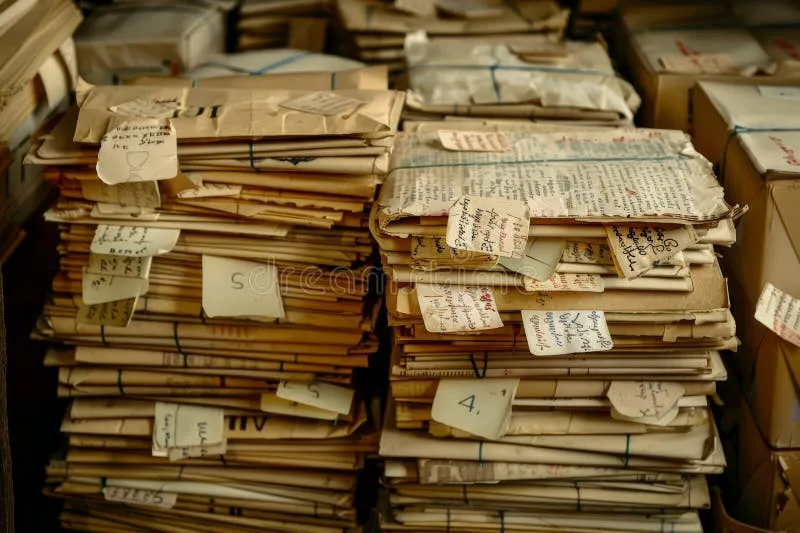
Photo: old letters shoebox attic dusty papers vintage correspondence, via thumbs.dreamstime.com
There's a particular kind of historical loss that's almost worse than the ordinary kind. Not a fire, not a flood, not the slow decay of neglect — but a clear Tuesday morning, a sensible woman, and a garbage bag.
In the spring of 1987, a woman in rural Pennsylvania decided it was finally time to deal with her late mother's attic. This is an experience familiar to millions of Americans: the boxes of things that meant something to someone once, the photographs of strangers, the papers no one has looked at in forty years. Most of it goes. That's just how it works.
Among the items she discarded was a shoebox containing a bundle of letters. She didn't read them carefully. They were old, the handwriting was difficult, and they didn't appear to be from anyone she recognized. Into the trash they went.
For the next several years, nothing happened. Then a historian looked at a photograph.
The Picture That Started Everything
The photograph wasn't even taken of the trash. It was a casual snapshot taken by the woman's daughter during the cleanout — one of those "let's document this chaos" pictures that families take during big projects. It showed the attic mid-purge: boxes stacked, furniture moved, piles of discarded items near the door.
The shoebox appears in the lower left corner of the frame, tipped on its side, letters fanned out slightly. The photograph ended up in a local historical society's collection years later, donated as part of a larger batch of rural Pennsylvania life documentation.
A historian researching an entirely unrelated topic — the domestic paper trails of mid-Atlantic families in the early twentieth century — was working through the collection when she stopped at that photograph. She asked for a high-resolution scan. Then she spent several weeks trying to confirm what she thought she was seeing.
What the Handwriting Suggested
Even in a photograph, at an angle, partially obscured: handwriting has a signature quality. Historians who spend years studying a particular person's correspondence develop a recognition for it that's almost intuitive — the slant of certain letters, the particular way a capital is formed, the spacing between words.
The historian believed she was looking at letters written by a man who would go on to hold significant political office in the United States. She's been careful, publicly, about saying more than that — partly because she can't prove it, and partly because the implications of what she can't prove are significant enough to require caution.
What she has said, in interviews and in a 2003 journal article that attracted considerable attention in academic circles, is that the visible portions of the letters suggested a personal correspondence — not political, not professional — between two people in a relationship that, based on the tone of what she could partially read, was not meant to be public knowledge.
The Romance That May Never Be Confirmed
The figure in question — whose identity the historian has declined to name outright, citing the inability to verify her reading of the photograph — was, at the time the letters would have been written, a rising political figure with a carefully maintained public image. A covert romantic relationship would have been, at minimum, professionally complicated.
The woman whose family owned the letters had no known connection to this figure. The historian's working theory is that the letters passed through several hands over the decades — possibly through the family of the woman the correspondence was addressed to — before ending up in that Pennsylvania attic.
Who that woman was, and what her relationship to the political figure actually involved, is now almost certainly unrecoverable. The letters are gone. The shoebox is gone. The woman who threw them away passed away in 2001, and her family has said she had no memory of reading them carefully enough to recall their contents.
The Photograph Remains
What's left is a single image, low resolution even when scanned at maximum quality, showing the edge of a historical record that no longer exists.
The historian has spent years — more than a decade, by her own description — working with forensic imaging specialists and handwriting analysts to extract whatever can still be extracted from that photograph. The results have been tantalizing and inconclusive in roughly equal measure.
She published her findings not as a revelation but as an absence: a documented hole in the historical record, shaped exactly like the thing that used to fill it.
What We Lose When We Clean House
This story is uncomfortable in a specific way. The Pennsylvania woman did nothing wrong. She had no reason to believe those letters were significant. Millions of Americans make the same decision every year — to discard the papers of people they didn't know well, or know at all — and almost every time, nothing is lost that anyone will ever miss.
Almost every time.
Historians have a term for this: "archival silence." The gaps in the record that aren't dramatic — no burning library, no deliberate suppression — just the ordinary accumulation of decisions made by people who had no idea they were making history.
A shoebox. A Tuesday morning. A garbage bag.
And somewhere in a journal archive, a footnote that says, essentially: we know something was here. We just can't tell you what it was.